

What Is a POCT Analyzer? Types, Applications and Benefits
A Point-of-Care (POCT) analyzer, commonly known as a bedside testing device, is a portable or compact bench-top in vitro diagnostic instrument. It performs tests on-site at the point where patient samples are collected, independent of the central clinical laboratory. With matched test cartridges/strips, it delivers test results within minutes.
It eliminates cumbersome procedures such as sample transportation, centrifugation and secondary verification on large analyzers. Operation does not rely on specialized laboratory technologists; nurses and primary care clinicians can operate it after brief training. POCT analyzers complement rather than replace large chemiluminescence and fully automatic biochemistry systems.
The Labsim L300 Immunofluorescence Analyzer, AFS2600B Fluorescent Immunoanalyzer and AFS3000 Automatic Fluorescence Immunoassay Analyzer all fall into the category of immunofluorescence lateral-flow POCT immunoanalyzers.
I. Classification by Instrument Form
♦ Handheld / Portable standalone units: Compact size with battery power supply. Low throughput and high flexibility for emergency departments, ambulances, community care, mobile screening and rural outreach health checks. (Example: Labsim L300)
♦ Small bench-top POCT analyzers: Deployed in clinical departments, fever clinics and private clinics. Capable of sequential testing with built-in printing and network connectivity.
♦ High-throughput fully automatic POCT platforms: Higher throughput for batch testing in clinical laboratories, tertiary hospitals and third-party testing facilities. They combine the speed advantage of POCT with mass screening capacity. (Examples: AFS2600B, AFS3000)
II. Classification by Detection Principle (Mainstream Industry Technologies)
♦ Fluorescence Immunochromatography Analyzer (FIA) Fluorescent microspheres are used for labeling, enabling quantitative detection with high sensitivity and strong anti-interference performance. It covers assays including CRP, SAA, PCT, IL-6, troponin and thyroid function. This is the prevailing upgrading trend within the IVD industry, and the core technology adopted by Labsim. Multi-analyte panel testing on a single cartridge is supported.
♦ Colloidal Gold Immunoanalyzer Low cost, mostly for qualitative or semi-quantitative testing, widely used in rapid test strips for influenza, COVID-19 and early pregnancy. Its limitation is relatively lower sensitivity, and many assays only provide positive/negative results.
♦ Dry Chemistry POCT Reactions take place on dry slides for testing of blood glucose, blood lipids, liver and kidney function, electrolytes.
♦ Blood Gas / Electrolyte POCT Analyzer Dedicated for emergency departments and ICUs, measuring blood gas, lactic acid and electrolytes to manage patients with respiratory disorders or shock.
♦ Coagulation POCT Analyzer Used to monitor INR and coagulation function for follow-up of patients on atrial fibrillation anticoagulation therapy.
♦ Microfluidic & Nucleic Acid POCT Integrated chips for rapid nucleic acid detection, applied to on-site molecular screening for infectious diseases.
III. Application Scenarios
♦ Emergency departments, ICUs, chest pain centers and ambulances (emergency care) Troponin, lactic acid, blood gas, PCT and CRP support rapid triage of myocardial infarction, sepsis and trauma, shortening the therapeutic window.
♦ Primary healthcare: township health centers, community clinics and private practices Inflammatory and chronic disease screening plus preliminary maternal screening, strengthening testing capacity at primary care sites and supporting tiered medical care.
♦ Long-term chronic disease management Follow-up visits for diabetes (HbA1c, glucose), heart failure and anticoagulated patients, enabling immediate medication adjustment. Data can be uploaded to HIS/LIS for electronic health record creation.
♦ Public health emergency response Large-scale on-site screening for infectious diseases such as influenza, malaria and hepatitis, disaster relief and port screening.
♦ Rapid departmental testing in tertiary hospitals, fever clinics, mobile medical vehicles, etc.
IV. Core Advantages of POCT Analyzers
♦ Rapid turnaround time (short TAT) No waiting for sample delivery; reports available within minutes, which is critical for emergency treatment decisions. Labsim fluorescence immunoassay models can complete cartridge reading in less than 10 seconds.
♦ Simple sample requirements with low blood consumption Most assays accept whole blood directly, and many do not require centrifugation. This is ideal for emergency cases, pediatric patients and critically ill patients with difficult blood collection.
♦ Low operational barrier One-step workflow: load cartridge → automatic identification → automatic interpretation → automatic waste cartridge ejection. Operable by nurses and primary care staff without dedicated laboratory personnel.
♦ Flexible deployment Compact footprint; no high-standard laboratory space or complex fluidic pipelines required. Some reagents can be stored at ambient temperature (2–30°C), lowering cold-chain burden and suiting remote regions and overseas markets.
♦ Digital networking and traceable quality control LIS/HIS connectivity, barcode patient registration, full audit logging and traceable QC to meet laboratory regulatory standards. Multi-language interface supports global IVD distribution.
♦ Diversified product portfolio A full lineup ranging from compact portable units to high-throughput systems, accommodating both bedside single tests and continuous batch screening. Multi-analyte panels (e.g., CRP+SAA, PCT+IL-6) on one cartridge reduce blood collection volume and reagent consumption.
V.Labsim POCT Immunoassay Analyzer
AFS-1000 Fluorescent Immunoanalyzer
This instrument is a single-channel entry-level dry fluorescent immunoassay platform. It features a compact structure and small footprint with favorable portability, suitable for low-volume testing scenarios including primary clinics, point-of-care emergency testing and mobile outreach screening. Centered on cost performance, it is ideal for medical institutions with limited budgets and sporadic low-volume testing demands. The instrument does not support parallel incubation or automatic sample addition; manual sample loading and test cartridge placement are required.
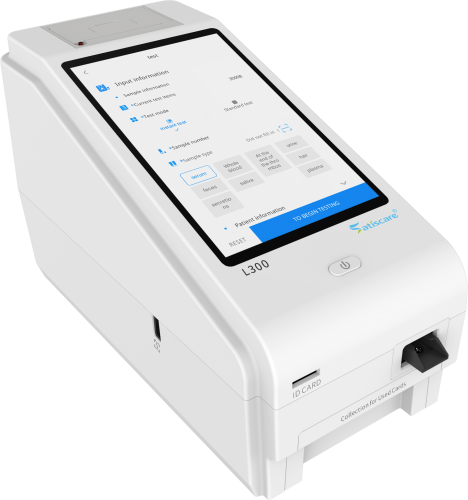
L300 Immunofluorescence Analyzer
The L300 is LABSIM's new-generation single-channel dry immunofluorescence analyzer, an upgraded successor to the AFS‑1000. It retains the single-channel testing architecture while delivering systematic optimizations in human-machine interaction and operational experience. Equipped with the Android operating system and an 8.1-inch high-definition touchscreen, it adopts a redesigned intuitive UI for streamlined operation. Maintaining a lightweight form factor, it comes with an integrated waste cartridge storage compartment for automatic waste cartridge collection after testing, which reduces biohazard contamination risks and simplifies bench workflows. Its calibrated optical detection unit enables rapid signal interpretation.
The L300 has a built-in thermal printer and supports external printers. It is equipped with barcode scanning, USB data export and LIS connectivity, and supports multi-language interfaces to meet export project requirements. It still requires manual sample addition and cartridge loading without multi-channel parallel incubation, making it suitable for community clinics, emergency point-of-care testing and small medical facilities.
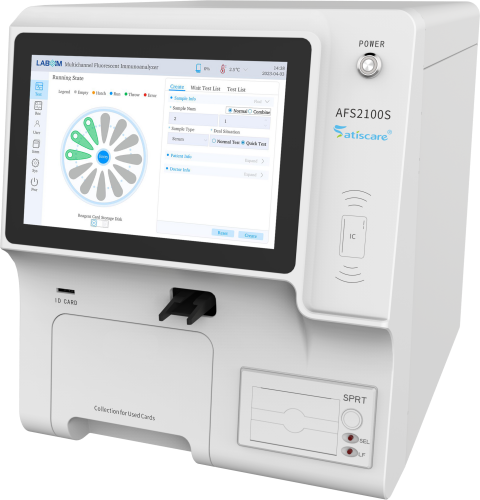
AFS2100S Multichannel Fluorescent Immunoanalyzer
The AFS2100S is a semi-automatic fluorescent immunoassay analyzer with 12 independent constant-temperature incubation channels. It targets primary medical institutions with moderate sample volumes and concurrent multi-assay testing needs, such as community health centers, general practice clinics, fever clinics and routine physical examination sites. It is configured with 12 thermally independent incubation channels with separate temperature control. Different assays can be initiated on demand without waiting for prior tests to finish, which flexibly adapts to randomly submitted samples. Its enclosed incubation chamber minimizes aerosol spread and improves intra-batch test repeatability. As a semi-automated platform, it relies on manual sample pipetting and cartridge loading and has no automatic piercing sampling or continuous track sampling structure. It resolves the queueing limitation of single-channel instruments at a moderate investment cost.
AFS2600B Immunofluorescence Analyzer
The AFS2600B is a compact track-based fully automated dry fluorescent immunoassay system. It is designed for township central hospitals, secondary hospital emergency departments and specialized clinics that demand automation with moderate daily sample throughput. Powered by the Android system and fitted with a 10.1-inch large touchscreen, it delivers a superior user experience and supports 4G transmission for seamless integration with hospital LIS and HIS systems. It incorporates reagent cartridge verification to alert operators of mismatched cartridges and mitigate human error. Among fully automated analyzers, it features a relatively small footprint with low site requirements and moderate overall investment. This fully automated system is well suited for outpatient departments and small medical facilities.
AFS3000 Automatic Fluorescence Immunoassay Analyzer
The AFS3000 is LABSIM's flagship high-throughput track-based fully automated analyzer on the fluorescent POCT platform. It is developed for high-workload settings including county-level general hospitals, tertiary hospital outpatient departments, independent clinical laboratories and large-scale physical examination centers. It achieves a throughput of up to 120 tests per hour and supports continuous rack sampling; additional samples can be loaded online without halting ongoing runs. It is equipped with 50 sample positions, zoned incubation modules and 5 large-capacity reagent cartridge magazines, each holding up to 45 cartridges. Built-in RFID reagent management enables reagent traceability and inventory monitoring.
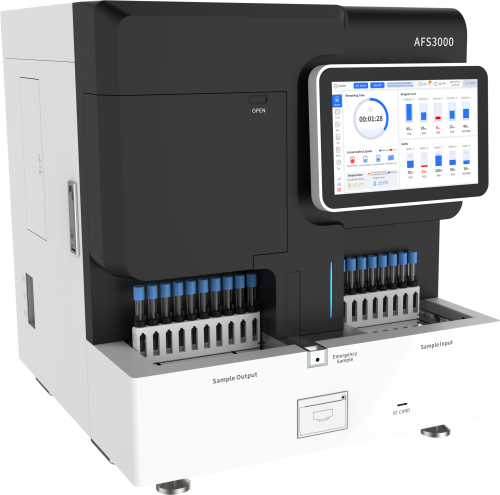
Integrated functions include sample mixing, barcode identification, piercing sampling and liquid level sensing. It is compatible with regular blood collection tubes, swab tubes, stool sample containers and other vessel types, and supports two-step dilution assays to accommodate complex panel tests such as cardiac markers, inflammatory indicators, thyroid function and infectious disease combination panels