

How Point-of-Care Testing (POCT) Is Changing Modern Healthcare
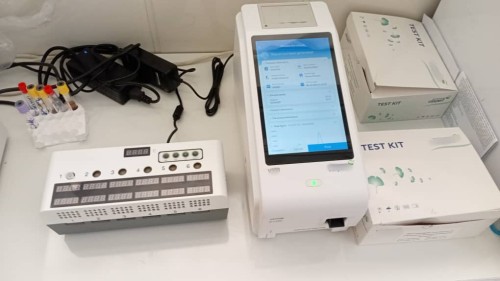
POCT (Point-of-Care Testing), also known as bedside testing, refers to rapid testing and result acquisition performed on-site where patient samples are collected, using portable analytical instruments and matched reagents. Centered on immediacy and convenience, POCT eliminates reliance on specialized laboratories and streamlines workflows to cut turnaround time. Labsim’s POCT Analyzer paired with Fluoroimmunoassay (FIA) Reagents delivers rapid test results.
Conventional laboratory testing has long depended on central clinical laboratories: after collection, samples go through transportation, pre-treatment, instrument analysis and report review, a process that often takes hours. For critically ill patients, every minute of delay can affect clinical outcomes. POCT brings testing devices to patients’ side, generating results within minutes at the sampling site. It reshapes the full workflow of diagnosis, triage, treatment and chronic disease management, making it one of the core driving forces behind the transformation of modern healthcare.
The most intuitive change brought by POCT is shortening diagnostic waiting time and redefining emergency care protocols. In time-critical settings including emergency departments, ICUs, ambulances and chest pain centers, POCT rapidly generates reports for cardiac troponin, blood gas, lactate, infectious markers, blood glucose and other parameters. Clinicians can triage patients by risk level and initiate treatment immediately without waiting for feedback from the central lab. For time-sensitive conditions such as sepsis, acute coronary syndrome and severe trauma, rapid POCT testing significantly extends the window for reperfusion and anti-infective interventions, lowering mortality in critical cases. It also eases emergency department overcrowding, reduces unnecessary observation and hospitalization, and improves hospital patient flow efficiency.
Secondly, POCT facilitates the outreach of medical resources and breaks geographic barriers to diagnostic capacity. Large automated biochemistry and immunoassay instruments impose strict requirements on space, power supply and trained operators, making them difficult to deploy in township health centers, community clinics, mobile screening vehicles, remote regions and disaster relief sites. By contrast, POCT devices are compact with low operational barriers, supported by integrated reagent kits. Frontline primary care staff can perform tests independently after brief training. POCT extends diagnostic capability to resource-limited areas, enabling rapid screening for underserved populations. It fills gaps in grassroots diagnostics for infectious disease screening, antenatal testing, initial chronic disease screening and post-disaster emergency care, narrows regional healthcare disparities and supports tiered medical care.
Thirdly, POCT shifts healthcare from hospital-centered centralized treatment toward patient-centric continuous health management. Chronic disease care is a prime example. POCT devices for blood glucose, HbA1c, coagulation and heart failure biomarkers enable real-time monitoring during outpatient follow-ups, home self-testing and community visits. Patients with diabetes, atrial fibrillation on anticoagulation therapy and chronic heart failure avoid repeated blood draws and long waits for results; physicians can adjust medication regimens on the spot based on test values. Certain smart POCT devices can connect to LIS and HIS systems for automatic data upload, building long-term health records and enabling dynamic follow-up. This model transforms episodic hospital-based care into continuous, lightweight monitoring, supporting early intervention and reducing the risk of long-term complications.
In public health, POCT serves as a vital tool for pandemic and infectious disease control. Rapid antigen or nucleic acid POCT assays for influenza, COVID-19, malaria, hepatitis and other pathogens are well suited for large-scale on-site screening. They enable fast population triage, isolation and epidemiological surveillance within a short timeframe. Independent of central laboratories, POCT can be rapidly deployed at outbreak sites, granting greater initiative for public health emergency responses.
That said, POCT is not a replacement for central laboratories; the two are complementary. Central labs undertake high-precision, high-volume and complex testing, while POCT handles rapid screening, bedside real-time assessment and field preliminary testing. Meanwhile, POCT introduces quality control challenges. Devices distributed across departments, community sites and home settings require unified quality management systems, regular calibration, staff training and data traceability to prevent biased results caused by non-standard operation. An increasing number of manufacturers connect POCT instruments to hospital-wide QC platforms to achieve traceable results, abnormal alerts and centralized quality control, complying with laboratory standards such as ISO 15189.
In summary, the value of POCT extends far beyond fast results. It reshapes sample logistics, clinical decision-making, resource allocation and patient management: accelerating emergency treatment, expanding diagnostic access at grassroots levels, enabling continuous chronic disease management and agile public health responses. As modern healthcare moves toward precision, accessibility and home-based care, POCT continues to lower diagnostic barriers and reduce therapeutic delay, ultimately delivering safer, more efficient and patient-friendly medical services.
Labsim POCT Immunoassay Analyzer & Immunofluorescence Reagents
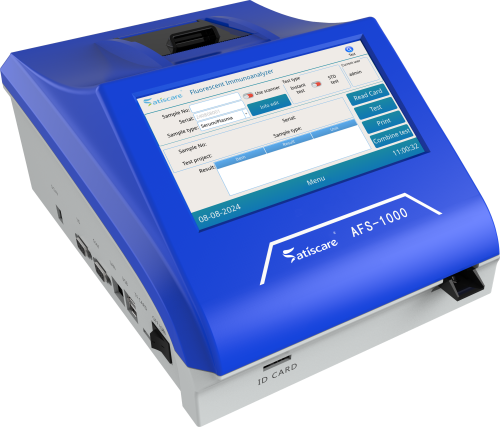
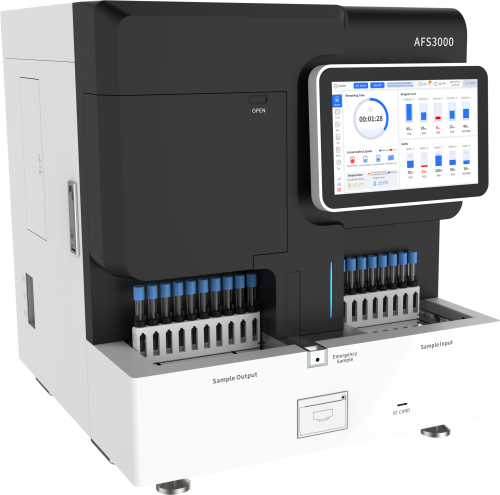
Labsim's complete POCT immunofluorescence solution adopts fluorescent immunochromatography technology. Our instruments and matched reagents are developed in-house. It covers bedside rapid testing scenarios including emergency departments, outpatient clinics, primary care clinics, ICUs, chest pain centers and fever clinics. The product portfolio includes portable standalone models (L300) as well as high-throughput automated systems (AFS2600B, AFS3000, etc.). With integrated instrument-reagent design and stable performance, the lineup meets demands of global IVD distribution channels.
Core Advantages of Immunofluorescence Analyzers (Instruments)
Extremely simple operation with a low learning curve, optimized for one-step POCT bedside workflows. Insert the reagent cartridge for automatic assay identification, interpretation, result output and cartridge disposal. No complex sample pre-treatment or professional laboratory technologist is required; nurses and primary healthcare workers can run tests independently after simple training.
♦ Fast detection for rapid critical care diagnosis Single-cartridge interpretation takes less than 10 seconds. Combined with sample incubation, quantitative results for most inflammatory and cardiac markers are available within minutes, supporting fast triage of patients with sepsis, acute coronary syndrome and infections. A built-in thermal printer generates hard-copy reports instantly.
♦ Broad sample compatibility Compatible with whole blood, serum, plasma, urine and other sample types. Whole blood samples require no centrifugation or only minimal pre-processing, cutting sample preparation time and suiting emergency on-site sampling.
♦ Smart connectivity, seamless hospital system integration and traceable quality control USB and Ethernet communication are supported for connection to LIS/HIS platforms with automatic data upload. The instrument stores tens of thousands of historical records. It supports barcode scanners for patient information entry and reagent cartridge barcode/QR code recognition. Multi-language interfaces are available for global markets. Full operational logging satisfies QC traceability requirements.
♦ Diversified instrument portfolio with flexible throughput for labs of all sizes
♦ Portable standalone model L300: ideal for small clinics, emergency rooms, community settings and mobile screening
♦ Multi-channel / automated models AFS2100S, AFS2600B, AFS3000: designed for high-volume continuous testing in clinical labs, tertiary hospitals and reference laboratories
♦ Single cartridges support multiplex assays for simultaneous detection of multiple markers (e.g., CRP+SAA, PCT+IL-6) to boost testing efficiency
♦ Robust, low-maintenance design Simplified mechanical structure with low failure rate; no complex fluidic circuits or routine flushing required. Batch calibration curves are automatically loaded via ID cards, eliminating calibration before every run, reducing workload and ensuring controllable long-term operating costs.
Core Advantages of Matched Immunofluorescence Reagent Kits
♦ Comprehensive assay menu covering mainstream clinical needs Over 100 assays are available, covering inflammation markers (CRP, SAA, IL-6, PCT), cardiac markers, thyroid function, sex hormones, diabetes, renal function, infectious diseases, tumor markers, anemia, allergens, rheumatism and more. Diverse clinical panel combinations support customized screening packages for different departments, forming an all-in-one POCT menu.
♦ Accurate quantitation, high sensitivity and strong anti-interference capability Built on fluorescent microsphere-labeled immunochromatography, the platform outperforms traditional colloidal gold: stronger signal, lower limit of detection and wider linear range. It effectively minimizes interference from blood matrix, hemolysis and lipemia, delivers excellent result repeatability and shows high correlation with large chemiluminescence analyzers. It supports clinical quantitative diagnosis rather than merely qualitative positive/negative interpretation.
♦ Favorable storage conditions with low logistics barriers Most kits can be stored at ambient temperature of 2–30°C without frozen cold-chain transportation. This greatly eases cold-chain management pressure for logistics, inventory and grassroots clinics, suitable for distribution in remote regions and overseas markets. Each kit comes with an ID calibration card with batch-specific calibration curves to control inter-batch deviation.
♦ Rich multiplex panel options with high clinical value Validated dual-marker cartridges (CRP/SAA, PCT/IL-6, etc.) report multiple correlated biomarkers from one test. They help clinicians rapidly distinguish bacterial versus viral infection and assess infection severity, reducing blood collection volume, consumable cost and turnaround time.
♦ Full regulatory compliance, supporting local registration and OEM cooperation Reagents hold certifications including CE and FDA. Reagent cartridges, diluents and calibration ID cards are supplied in standardized complete packs. Custom
OEM services are available to meet private-label requirements of international IVD partners.
Labsim instruments and reagents are co-developed and calibrated as a unified system, delivering stable CV and accuracy. Catering to both bedside rapid testing and high-throughput batch testing, we provide an integrated POCT solution covering instruments, reagents, quality control and after-sales service.