

How Automated Slide Labeling Reduces Errors in Histology Laboratories
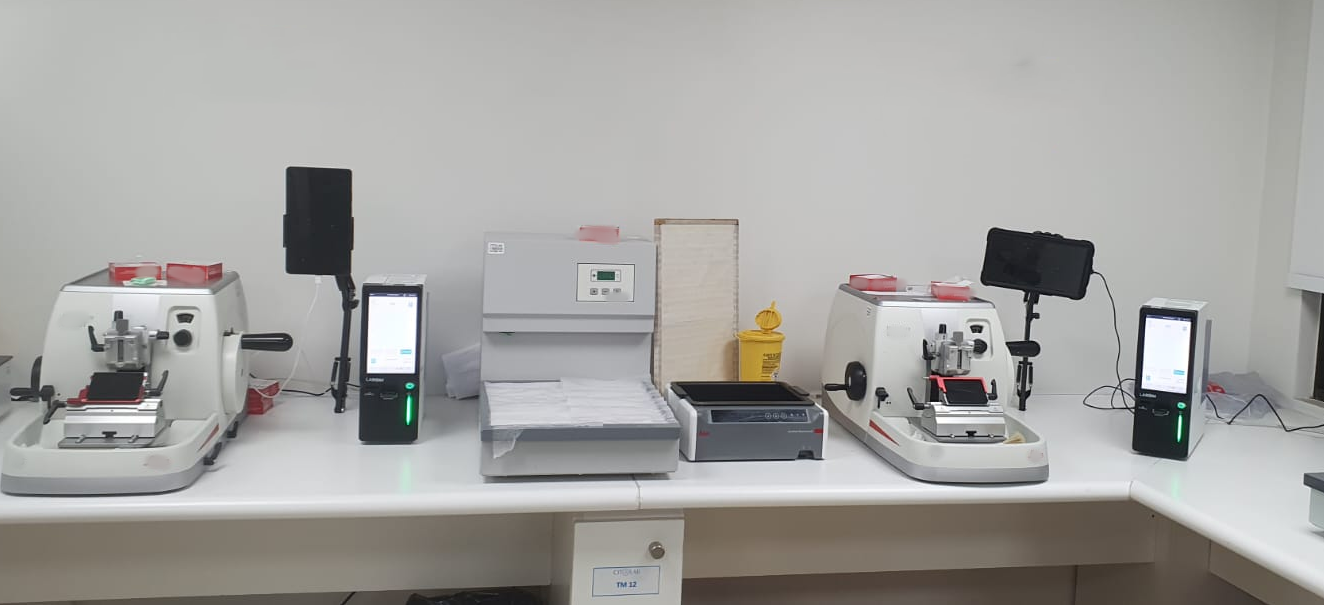
Automated slide labeling technology significantly reduces the risks of sample mix-ups, manual data entry errors and label detachment in histopathology laboratories through standardized marking, automated workflows and digital traceability. Below are the core mechanisms by which this technology mitigates error risks:
1.Elimination of manual entry and marking errors
Traditional manual or semi-automated labeling is prone to illegible handwriting, misaligned marking or data entry mistakes caused by fatigue or oversight. Automated slide labeling systems (such as inkjet or laser slide printers) connect directly to the Laboratory Information System (LIS) to enable automatic data transfer and printing.
♦ Consistent precision: Automated equipment guarantees highly uniform font, print position and clarity in every output, avoiding identification difficulties under the microscope.
♦ Chemical resistance: Specially formulated inks or laser engraving produce markings resistant to pathological reagents including xylene, ethanol and formalin, preventing label dissolution or detachment during staining and dehydration, and thus eliminating the risk of losing sample identity.
2.End-to-end sample traceability and anti-mixup control
Automated labeling systems are usually integrated with barcode or QR code technology to assign a unique digital identity to each sample.
♦ Closed-loop management: Every step from specimen receipt, grossing and embedding to sectioning and staining can be verified via barcode scanning.
♦ Automated sorting and collection: Some high-end models equipped with auto-collection trays can arrange slides sequentially after printing, reducing sequence disruption during manual transport and sorting.
3.Improved productivity and standardization
Slide labelers are ideal for high-volume histopathology laboratories. Automated labeling frees technologists from repetitive marking work, enabling fast and accurate sample identification so staff can focus on critical technical procedures.
♦ High-throughput processing: Advanced printers can reach a speed of 20 slides per minute or higher, supporting high sample workloads in large laboratories while maintaining consistent print quality.
♦ Intelligent integration: Combined with AIOCR (Artificial Intelligence Optical Character Recognition), the system can also recognize existing labels and auto-populate data into the LIMS, bridging gaps between physical labels and digital systems and further cutting secondary manual entry errors.
4.Facilitated quality control and accountability traceback
Clear automated markings lay the foundation for downstream quality control and error investigation.
♦ Versatile readability: Printing is supported on different slide coating surfaces for easy differentiation.
♦ Auditable data: A log is generated for all labeling activities. In the event of an error, the relevant process stage, equipment and operation record can be quickly located to support continuous workflow improvement.
In histopathology laboratories, automated slide labeling technology is far more than a simple “slide marker”. It serves as critical infrastructure for building smart pathology departments, safeguarding patient safety and ensuring diagnostic accuracy. It embeds standard operating procedures through technology and minimizes risks introduced by human variability.
Labsim G306 Slide Thermal Printer
The Labsim G306 Slide Thermal Printer is an automated slide labeling device designed for histopathology workflows. It replaces handwritten marking and adhesive labels by printing specimen identifiers directly onto the frosted area of standard glass slides. It covers the full workflow from grossing, embedding and sectioning to staining, microscopy and archiving, establishing a one-to-one linkage between paraffin blocks and sections. Acting as a hardware node for specimen tracking within LIS/HIS, it prevents slide mix-ups and mislabeling to mitigate major diagnostic risks.
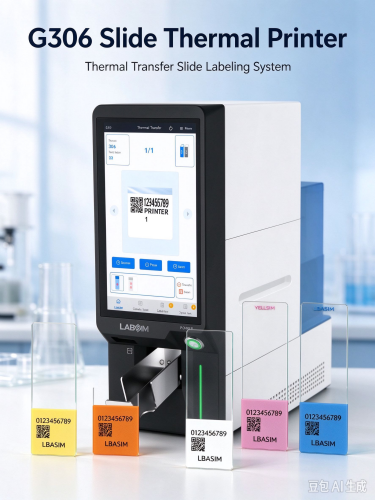
Compact in footprint, the Labsim G306 can be placed beside or directly on top of a rotary microtome. Technologists can print slides immediately after sectioning, enabling in-station labeling instead of batch printing in a separate room. This streamlines the sectioning workflow, boosts daily throughput, and is suitable for HE staining, IHC and special stain slides.
Key Advantages of the G306
- It adopts thermal transfer ribbon printing. No dust or fumes are generated during operation, creating a safer and more comfortable working environment for operators.
- Printed markings withstand immersion in xylene, ethanol, deparaffinization reagents and mounting medium. Text and barcodes remain intact and legible after complete HE and IHC staining cycles for long-term archive storage.
- Dual independent slide cassettes, each holding up to 130 slides for a maximum capacity of ≥260 slides. Two slide types (e.g. routine HE slides and IHC adhesive slides) can be loaded simultaneously for on-demand printing without frequent slide replacement.
- Fast printing speed and user-friendly ribbon replacement: ribbon change can be completed within 3 seconds. Unlike many competing models that require partial disassembly and tension adjustment, it minimizes workstation downtime and sustains continuous sectioning workflows.
- Ultra-slim design with a width of only 110 mm and minimal bench space occupation. It can be mounted above microtomes to combine sectioning and labeling at one workstation, with no dedicated labeling room required. It is well suited for space-constrained small and medium-sized pathology labs, referral laboratories and third-party ICLs.
- Built-in template editor supports flexible layout of text, barcodes and logos, allowing standalone operation without a host computer.
- Multiple communication interfaces including Ethernet, serial port and USB for integration with LIS/PIS/HIS. It supports bulk job downloading, scan-to-print triggering and external barcode scanner connection.
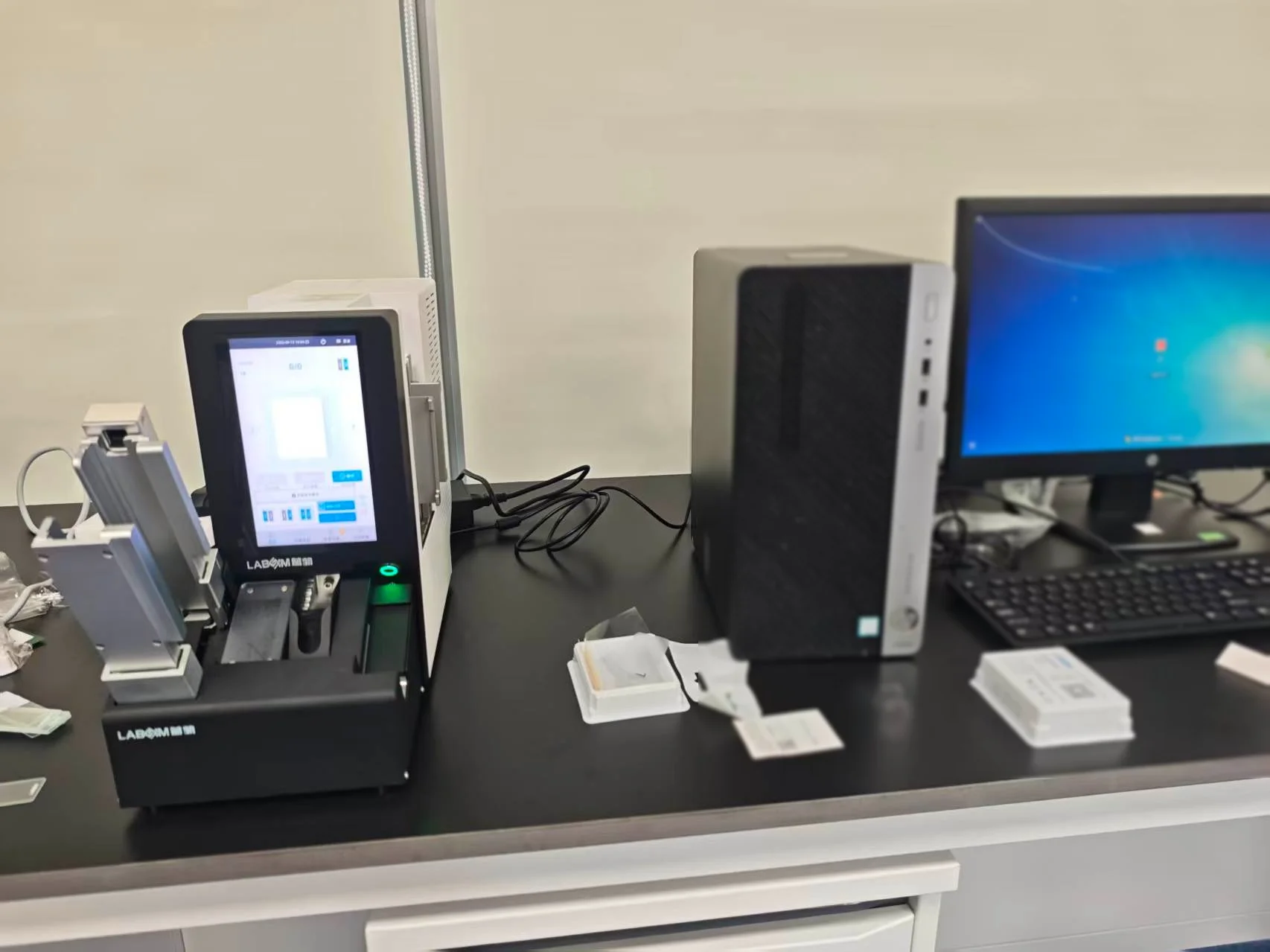
The Labsim G306 Slide Thermal Printer is a fit-for-purpose thermal transfer slide marker for this scenario. It prints identifiers on the frosted zone of standard slides and supports HE, IHC and special staining workflows. Its highlights include dust-free, odourless operation, robust chemical resistance, dual slide cassettes, ultra-compact size for placement beside microtomes, quick ribbon swap, built-in template editing and flexible connectivity to LIS/PIS/HIS.
More than a marking tool, automated slide labeling forms core infrastructure for smart pathology labs. It locks in standard SOPs and limits variability caused by human factors to protect patient safety and reliable diagnosis.